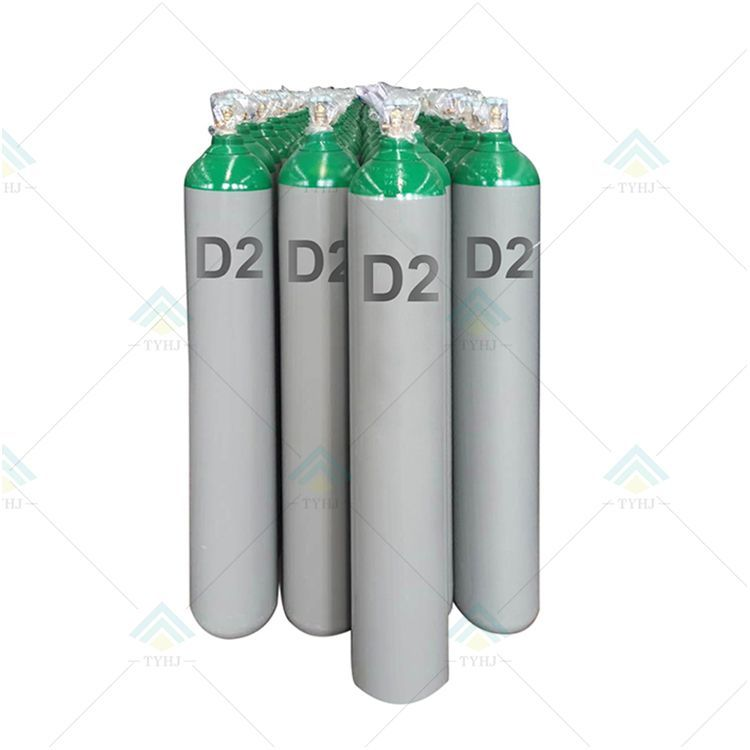
D2 Specialty Gas, also known as deuterium gas (D₂), is an important high-purity specialty gas widely used in advanced industrial and scientific fields. Because deuterium is a stable isotope of hydrogen, it has unique physical and chemical properties that make it extremely valuable in precision research, analytical instruments, semiconductor manufacturing, and advanced material development.
As industries continue to demand higher accuracy, stability, and purity, D2 Specialty Gas has become an essential component in many high-tech processes. Understanding its main industrial applications can help buyers, laboratories, and manufacturers choose the right supplier and ensure optimal performance.
One of the most common applications of D2 Specialty Gas is in spectroscopy equipment, particularly in deuterium lamps used for ultraviolet (UV) spectroscopy.
Deuterium lamps provide a stable and continuous ultraviolet light source, which is critical for analytical techniques such as:
UV-Vis spectroscopy
Atomic absorption spectroscopy (AAS)
Chromatography detection systems
Environmental monitoring instruments
Compared with traditional light sources, deuterium-based lamps deliver stronger UV output and better stability, making them ideal for laboratories and industrial testing facilities that require high analytical accuracy.
Industries that rely heavily on this application include:
Pharmaceutical laboratories
Environmental testing agencies
Chemical analysis laboratories
Food safety inspection institutions
The semiconductor industry is another major user of D2 Specialty Gas. With the increasing complexity of microchips and integrated circuits, manufacturers require gases with ultra-high purity and consistent performance.
In semiconductor fabrication, D2 gas is commonly used for:
Process gas in thin film deposition
Surface passivation
Plasma processes
Advanced material research
Deuterium offers better bond stability compared to hydrogen, which can help improve device reliability and extend the lifespan of semiconductor components. As chip technology continues to move toward smaller nodes and higher integration, the demand for high-purity specialty gases like D2 is expected to grow steadily.
Research institutions and laboratories frequently use D2 Specialty Gas for various experimental purposes. Because deuterium behaves similarly to hydrogen but has a slightly different atomic mass, it plays an important role in isotope studies and reaction tracking.
Common laboratory applications include:
Isotope labeling experiments
Reaction mechanism research
Nuclear magnetic resonance (NMR) studies
Chemical reaction tracing
These applications help scientists understand complex chemical reactions, molecular structures, and reaction pathways, making D2 gas an important resource in advanced scientific research.
Deuterium is also widely used in nuclear science and energy research, particularly in projects related to fusion energy.
In nuclear applications, D2 gas may be used for:
Fusion reaction research
Neutron moderation experiments
Nuclear material studies
As the global energy sector continues to explore clean and sustainable energy sources, deuterium-based technologies are receiving increased attention. This trend is likely to drive future demand for high-purity D2 Specialty Gas in research facilities and energy laboratories.
Another important application of D2 Specialty Gas is in advanced material development and testing. Deuterium is often used to study material stability, hydrogen interactions, and molecular behavior.
Industries involved in material innovation may use D2 gas for:
Hydrogen interaction studies in metals
Battery and energy storage research
Surface chemistry analysis
Nanomaterial development
Because deuterium reacts differently than hydrogen in certain conditions, researchers can use it to better understand material durability, chemical bonding, and performance under extreme environments.
High-precision analytical equipment often requires stable calibration gases to maintain measurement accuracy. In some specialized instruments, D2 Specialty Gas plays a role in calibration or performance verification.
This is particularly relevant for industries that depend on extremely accurate measurements, such as:
Environmental monitoring
Industrial quality control
Pharmaceutical production
Chemical manufacturing
Using high-purity specialty gases ensures consistent test results, reliable instrument performance, and regulatory compliance.
The growing industrial demand for D2 gas is largely due to several key advantages:
High stability – Deuterium provides stable performance in analytical and industrial applications.
High purity availability – D2 Specialty Gas is typically available in ultra-high purity grades suitable for sensitive equipment.
Improved analytical accuracy – It helps enhance measurement precision in spectroscopy and laboratory analysis.
Wide industrial compatibility – It supports applications in electronics, research, energy, and material science.
As modern industries demand higher precision and more advanced technologies, D2 Specialty Gas has become an essential resource across multiple sectors. From spectroscopy and semiconductor manufacturing to nuclear research and advanced materials development, its unique properties make it indispensable for high-performance applications.
With the continued growth of high-tech manufacturing, scientific research, and clean energy development, the global demand for high-purity D2 Specialty Gas is expected to expand in the coming years. Businesses that rely on accurate measurements, advanced materials, and cutting-edge technologies will increasingly depend on this specialized gas to achieve reliable and consistent results.

Search News